Sunday, October 10, 2010

SNAKES

We live in a region where there are supposed to be many snakes, but in the 5½ years we have been living here, I have seen only five snakes (an average of about one per year!) and only one of those was potentially very dangerous, namely a mamba lying in the shade of a car parked in front of our house. The other four were two harmless spotted bush snakes, one mildly venomous redlipped snake and one dangerous young puff adder.

Many people have very confused ideas about snakes, as a snake expert, Johan Marais, points out in his book A Complete Guide to the Snakes of Southern Africa. He lists some of the misconceptions:
You frequently hear about large mambas, stretching from one side of the road to the other, but the maximum size recorded is about 4,5 m.
All snakes spit their venom! Wrong, in our area only the rinkhals and the Moçambique spitting cobra do that.
The snake can sting with its forked tongue! Nonsense, its tongue is only for smelling, it can not even lick with it.
The puff adder strikes backwards! No, it can only strike forwards or sidewards.
Snakes move in pairs and if you kill one, its mate will come looking for you! Superstition! Snakes do not have constant companions, they live alone and only mate in the spring.
Do snakes have nests? Not our snakes, but the King Cobra of Asia sometimes builds a rough nest, our snakes live in holes or under a rock or tree stump.
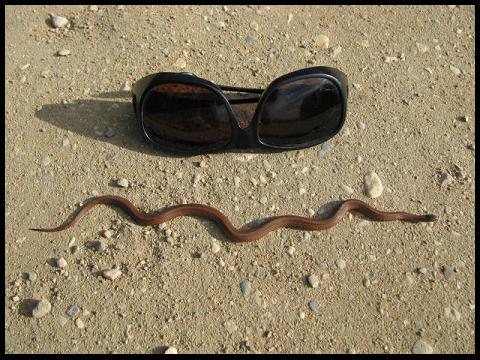
In South Africa we have only a few very poisonous snakes: most adders; the mambas; the cobra family; the yellow bellied sea snake; the vine snake; and the boom snake. Most of the snakes are completely harmless or mildly venomous and quite lot of them are extremely useful as they feed on the rodents and insects like snails and beetles.

Moral: Do not kill every snake that crosses your path!

Oupa

Wednesday, September 8, 2010

THE SIZE OF THE EARTH


In ancient times it was thought that the earth was flat, covered by a dome (with windows through which the rain fell) where the stars were situated and along which the sun and the moon revolved around the earth!  Then some people living near the sea, noticed that when ship sailed away the hull of the ship disappeared first while the sails were still visible and that led the to the idea that the earth was not flat!  Then they also noticed that when travelling far north or far south some stars would disappear and new ones appear!  As far as we know, the first person to state that the earth was a sphere, was a Greek named Philolaus of Tarentum who in 450 B.C. put forward this view and by 350 B.C. this was generally accepted, by learned men all over the known world and the they started speculating about the size of the earth.

Then a Greek philosopher, Eratosthenes of Cyrene (276 – 196 B.C.) was told that on summer solstice (21 June) at midday a vertical rod would cast no shadow in Syene (which was situated just about on the Tropic of Capricorn – when the sun would be directly overhead), but a rod in Alexandria, about 800 km north of Syene, would cast a short shadow, indicating that the sun was there about 7° south at the same time!  Eratosthenes then used this to calculate the circumference of the earth:  If  7° equalled 800 km, then 360° would be about 41 000 km!  Modern methods have arrived at a figure of 40 067,78 km at the equator, so hats off to mr Eratosthenes who was born 2286 years ago!

But this figure sounded too high for some people and later astronomers arrived at a figure of about 29 000 km which was accepted up to the time of Columbus who used these figures to convince his backers that he could easily reach Asia by sailing westwards over the Atlantic Ocean, but in fact it was not, because America occupied the place where they thought Asia should be!

The moral of the story:  Do not jump to conclusions!

Oupa

Thursday, August 12, 2010

A PARABLE

It being Sunday, I think a parable would be quite in order. The following story was told to me by a well-known Afrikaans churchman.


The congregation had been invited to a attend a Bible quiz between two teams consisting of the elders of the congregation and Oom Danie was very surprised (so he said!) that he had not been chosen to partake in the quiz, so he visited the parson and aired his misgivings. He reminded the parson that he had been a serving member of the church council for very many years and had always taken part in all the discussions of the council and that he thought that omitting a prominent member of the council could be regarded as a slap in the face. So, to keep the peace, it was decided to increase the quiz teams by two more members.


It all went very well until the parson, acting as quiz master, asked Oom Danie a question:

Parson: "Oom, What is the distance between Dan and Beersheba?"

Oom Danie: "Parson, what do you mean by this question?"

Parson: "Oom, as you know, Dan was in the very north of Israel and Beersheba was more or less the most southern town in Israel. An answer to the nearest 50 kilometers would be acceptable."

Oom Danie: "Parson, do you want to tell me the Dan and Beersheba were places, I always thought they were man and wife, just like Sodom and Gomorrah!"


The moral of the story is: Do not think too much of yourself!


Oupa

THE AGE OF THE EARTH

In the paper today I found a very interesting piece! Two professors at the NW University took on a colleague who had written (my translation!) in a journal: "Mankind did not come from any animal and all species can not be coupled to each other." The two who replied stated: "Such a short and sweet conclusion denies a lot of scientific results of evolutionary biology." (Again my own translation!) This little bit of news sparked a question in my mind: How old is the Earth?


I consulted some scientific books on astronomy and found very interesting facts!


1. A Greek philosopher, Xenophanes (560 – 478 B.C.) had already pointed out that the earth must be very old as he had seen seashells embedded in rocks on mountains, which meant that the sea level must have been much higher in the past and that this type of change could only occur over long periods of time.

2. A church historian, Eusebius of Caesarea (260 – 340 AD) used statements in the Bible to calculate the birth of Abraham and decided that it took place in 2 016 B.C.

3. Some Jewish rabbi's went even further and used the genealogy given in Genesis to calculate the creation of the earth and arrived at a figure of 3 761 B.C., still being used by the Jews as this is the year 5 670 in their calendar.

4. Then an Anglican bishop, James Ussher (1581 – 1656) calculated from data in the Bible that the earth was created 4 004 years before the birth of Christ which makes the earth (and the rest of the universe) 6 014 years old.


Yet many prominent persons were not satisfied with an answer of "about 6 000 years" and the first to say so openly and in detail was a French naturalist, Georges de Buffon (1707 – 88). He spent fifty years writing a 36 volume encyclopedia on natural science and in the fifth volume, published in 1778, he gave his ideas on the development of the Earth and theorized that the sun and another heavy body had collided and thus formed the earth which in time cooled down and animals, and finally, mankind appeared on earth. He also imagined a form of evolution though degeneration – some horses degenerating into donkeys and some men into apes.


I rather fancy the last one as I know quite a number of people who behave like apes!


Oupa

THE AGE OF THE EARTH

In the paper today I found a very interesting piece! Two professors at the NW University took on a colleague who had written (my translation!) in a journal: "Mankind did not come from any animal and all species can not be coupled to each other." The two who replied stated: "Such a short and sweet conclusion denies a lot of scientific results of evolutionary biology." (Again my own translation!) This little bit of news sparked a question in my mind: How old is the Earth?


I consulted some scientific books on astronomy and found very interesting facts!


1. A Greek philosopher, Xenophanes (560 – 478 B.C.) had already pointed out that the earth must be very old as he had seen seashells embedded in rocks on mountains, which meant that the sea level must have been much higher in the past and that this type of change could only occur over long periods of time.

2. A church historian, Eusebius of Caesarea (260 – 340 AD) used statements in the Bible to calculate the birth of Abraham and decided that it took place in 2 016 B.C.

3. Some Jewish rabbi's went even further and used the genealogy given in Genesis to calculate the creation of the earth and arrived at a figure of 3 761 B.C., still being used by the Jews as this is the year 5 670 in their calendar.

4. Then an Anglican bishop, James Ussher (1581 – 1656) calculated from data in the Bible that the earth was created 4 004 years before the birth of Christ which makes the earth (and the rest of the universe) 6 014 years old.


Yet many prominent persons were not satisfied with an answer of "about 6 000 years" and the first to say so openly and in detail was a French naturalist, Georges de Buffon (1707 – 88). He spent fifty years writing a 36 volume encyclopedia on natural science and in the fifth volume, published in 1778, he gave his ideas on the development of the Earth and theorized that the sun and another heavy body had collided and thus formed the earth which in time cooled down and animals, and finally, mankind appeared on earth. He also imagined a form of evolution though degeneration – some horses degenerating into donkeys and some men into apes.


I rather fancy the last one as I know quite a number of people who behave like apes!


Oupa

THE AGE OF THE EARTH - CONTINUED

A geologist, James Hutton (1726 – 1797), stated that it is evident that some rocks were formed by sediments compressed in layers, other rocks were certainly formed by volcanic action and exposed rocks were worn down by the action of wind and water, and so on. He also pointed out that this process was slow and also assumed that this process had probably always been going on at the same slow rate and that the Earth must be much older that the 6 000 years or so postulated by previous claims. He published this in a book Theory of the Earth in 1785 and is commonly regarded as the "father of geology".


And then, in 1896, Antoine Henri Becquerel (1852 – 1908), discovered radio-activity! Physicists soon found that the heavy metals, uranium and thorium, gave off radiations and were giving off heat continually, because atoms were breaking down. Ernest Rutherford (1871 – 1937) showed in 1904 that particular varieties of atoms broke down at fixed rates and this led to the discovery that in any such a reaction, half of the atoms breaking down would do it in a certain time interval, say x years and half of what remained would break down in an additional x years, and so on, and that period is called the "half-life". It was also found that elements could consist of different isotopes, a term that means that the different forms still had the same chemical features but that the atomic mass was different.


The first element found to be radio-active is uranium and it consists of two isotopes, namely uranium-238 (meaning an atomic mass of 238) and uranium-235 and the half-life of U-238 is 4 500 000 000 years and that of U-235 is 700 000 000 years. The second element found to be radioactive is thorium, which has only one form with a half-life of 13 500 000 000 years. In that same year of 1904, Bertram Borden Boltwood (1870 – 1927) discovered the fact that both uranium and thorium break down to final non-radio-active products, uranium-238 ended as lead-206, uranium-235 as lead-207 and thorium as lead-208, three of the four isotopes of lead. Boltwood also showed in 1907 that these facts could be used to calculate the age of rocks on earth by measuring how much lead of each isotope the rocks contained and today scientists agree that the age of the earth is of the order of 4 500 000 000 years.


Quite a bit older than I am!


Oupa

PERCEPTIONS

The Concise Oxford Dictionary defines perception, among others, as: intuitive recognition of (something), but I would like to add: by the use of our experience and knowledge. To illustrate this definition, the following story.


Our granddaughter is pregnant with her second child and had a sonar taken some time ago in which it was evident that the second child is female, and the other day she had an appointment with the doctor for a second sonar and intended taking her firstborn, Johann, aged about a month short of 3 years along as it was a Saturday and he could not attend the play group. The following conversation took place between father Hendrik and son Johann:


Hendrik: Johann, your mother is going to see the doctor who will look at your sister to see if she is doing well.

Johann: That's good, she can then sit on my lap when we come back.


Hendrik then had to explain to Johann that the doctor used sonar to inspect his sister and that she had to remain where she was for another ten weeks or so, but all of us find Johann's reaction hilarious, because we know what a sonar does, but Johann has never seen a sonar picture and has no idea of how it is taken!


We form perceptions about things, frequently with only partial understanding of the subject, should we not try to find out more about the subject? Do we learn anything from this?


Oupa